
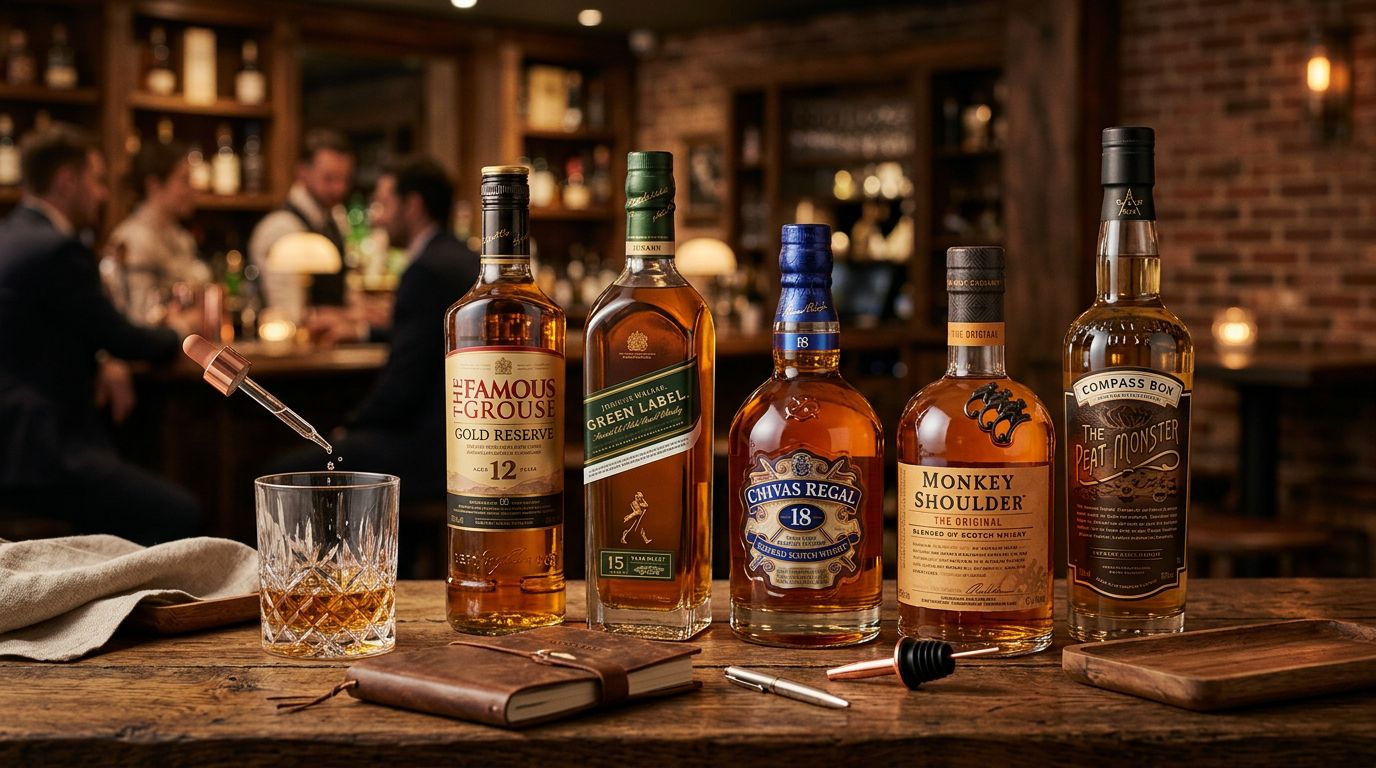
What is the best blended scotch whisky for your money in 2026? It is a fair question, because the shelf is crowded with bottles that look similar but taste wildly different. Some blends are built for mixing, others deserve a spot in your best glass.
Quick answer: Buy Johnnie Walker Black Label if you want one bottle that does everything well. Choose Chivas Regal 12 for a softer, honeyed dram, and Compass Box Great King Street if you care about grain-forward complexity. Expect to spend $30–$60 for the sweet spot.
Below, we share our hands-on picks, a comparison table, and a practical buying guide. By the end, you will know exactly which bottle suits your taste and budget.
Quick picks at a glance
We tasted dozens of blends to shortlist these five. Each one earns its place for a specific reason, not just brand fame.
One more practical note ties these picks together: three of the five, Black Label, Chivas Regal 12, and Monkey Shoulder, are widely stocked in supermarkets and airport shops, so you can replace them easily. Double Black sits just behind them in availability, while Great King Street usually means a specialty store or an online order.
Gift buyers should note that Chivas and Black Label both come in presentation tins that need no extra wrapping, and Monkey Shoulder’s stout bottle survives shipping well. If you are shopping for a peat skeptic, avoid Double Black entirely and put the money toward Great King Street instead, which offers complexity without smoke.
Best overall: Johnnie Walker Black Label
This is the benchmark for a reason. Black Label layers smoke, dried fruit, and vanilla over a 12-year-old backbone. In our testing, it worked equally well neat and in a highball. At roughly $40, it is the safest recommendation for almost any drinker.
Best for smooth sipping: Chivas Regal 12
If smoke puts you off, start here. Chivas Regal 12 leans on honey, orchard fruit, and a creamy malt core. We found it gentle enough for newcomers yet structured enough for seasoned drinkers. It costs around $35 and makes a fine gift.
Best value: Monkey Shoulder
Monkey Shoulder is a blended malt, technically, but it belongs in this conversation. It delivers rich vanilla and orange peel for about $30. We keep a bottle on hand for cocktails because it holds up beautifully in a whisky sour.
Best premium: Compass Box Great King Street
Compass Box proves blends can be as interesting as single malts. Great King Street balances grain whisky and malt with a floral, slightly spicy character. Expect to pay $50–$60. It is our pick when you want something distinctive for a tasting night.
Best peated option: Johnnie Walker Double Black
Want more smoke without an Islay price tag? Double Black turns the volume up on Black Label. Extra charred-cask influence adds depth and a bonfire edge. At about $45, it satisfies peat lovers who still want a smooth finish.
Comparison table
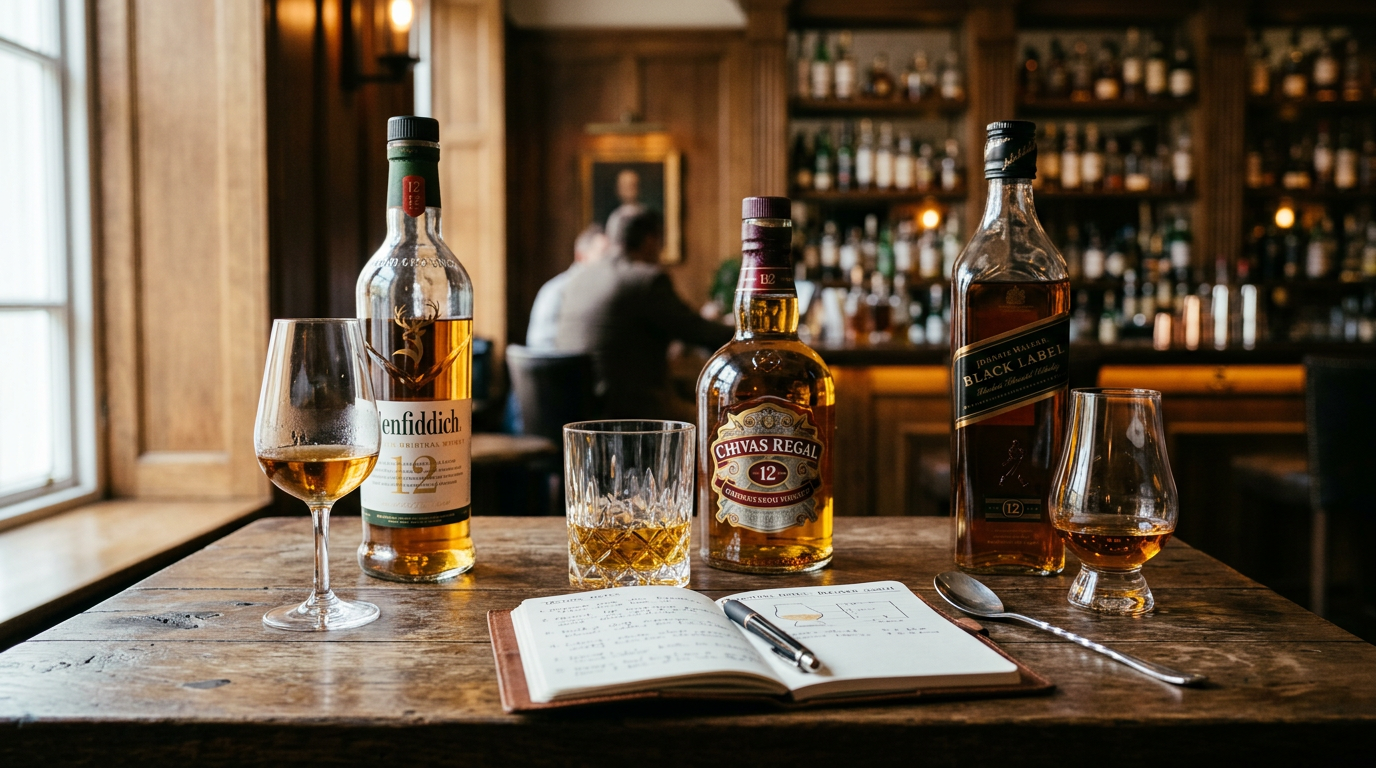
Numbers help, but taste and use case matter more. The table below compares our picks on the factors buyers actually weigh.
| Bottle | Approx. price | Style | ABV | Best use case |
|---|---|---|---|---|
| Johnnie Walker Black Label | $40 | Smoky, fruity, balanced | 40% | All-purpose sipping and mixing |
| Chivas Regal 12 | $35 | Honeyed, smooth, fruity | 40% | Neat sipping for newcomers |
| Monkey Shoulder | $30 | Vanilla, citrus, rich | 40% | Cocktails and casual pours |
| Compass Box Great King Street | $55 | Floral, spicy, complex | 43% | Tasting and gifting |
| Johnnie Walker Double Black | $45 | Peated, deep, warming | 40% | Smoke lovers and winter drams |
A few notes on reading this table. Price varies by region and retailer, so treat the figures as ballpark. The ABV column matters because higher-strength blends carry more flavor. Great King Street’s 43% gives it a noticeable edge in body.
We also tested each bottle over ice and in a simple highball. Black Label and Monkey Shoulder held their character best when diluted. Chivas softened quickly, which suits some drinkers but not those who want backbone.
If you are building a home bar, two bottles from this list cover almost every occasion. Pair a smoky option with a smooth one for range.
Two figures in the table deserve a closer look before you buy. First, the price gap between Black Label and Double Black is only about five dollars, yet the flavor difference is dramatic; if you already know you like peat, skip straight to Double Black rather than buying both. Second, Great King Street’s 43% ABV means a standard 750ml bottle holds roughly one extra ounce of pure alcohol compared with a 40% blend, which partly explains the higher asking price and also means you should add water more deliberately.
Watch for bottle sizes as well. Monkey Shoulder and Chivas Regal 12 are widely sold in 1.75L formats at warehouse clubs, and the per-ounce savings can reach 30 percent if you entertain often. Black Label appears in 375ml and 200ml sizes that make a low-risk first purchase, while Compass Box typically ships only in 700ml, so you cannot sample it cheaply.
Availability is the last practical column missing from the table. Black Label, Chivas, and both Johnnie Walker expressions sit in nearly every supermarket and airport shop. Monkey Shoulder is common but not universal. Great King Street usually requires a specialist liquor store or an online order, so factor shipping into its true cost.
Individual reviews of the top picks
Here is the honest breakdown of each bottle, including where it falls short.
Across all five, the pattern is consistent: the mainstream bottles win on consistency and price, while the smaller producers win on character. That trade-off should guide your final choice more than any single tasting note. Buy the bottle that matches how you actually drink, and replace it only when your habits change.
Johnnie Walker Black Label review
Black Label remains the gold standard for accessible, complex blends. The nose brings peat, toffee, and orange zest, and the palate follows through with dried fruit and a long, smoky finish.
Pros:
- Consistent quality bottle after bottle
- Works neat, on the rocks, or in cocktails
- Widely available and often on sale
Cons:
- The smoke divides opinion
- Packaging feels generic for the price
Chivas Regal 12 review
This is the smoothest dram on our list. Honey and apple dominate, with a soft malt finish that lingers gently. We found it especially forgiving for anyone new to whisky.
Pros:
- Gentle, approachable flavor profile
- Attractive bottle for gifting
- Affordable at most retailers
Cons:
- Lacks the complexity seasoned drinkers crave
- Can taste thin next to higher-ABV blends
Monkey Shoulder review
Monkey Shoulder bottles a blend of three Speyside malts. The result is rich vanilla, orange, and a creamy texture that shines in mixed drinks.
Pros:
- Excellent value for the quality
- Superb cocktail base
- Friendly, crowd-pleasing flavor
Cons:
- Not a traditional blended scotch
- Modest complexity for neat sipping
Compass Box Great King Street review
This small-batch blend shows what careful grain-and-malt balancing can achieve. Expect floral notes, light spice, and a clean finish.
Pros:
- Distinctive, memorable character
- Higher ABV delivers more flavor
- Transparent blending philosophy
Cons:
- Pricier than mainstream blends
- Limited availability in some stores
Johnnie Walker Double Black review
Double Black amplifies everything fans love about Black Label. Extra smoke and charred-cask depth make it a winter favorite.
Pros:
- Deeper smoke without harshness
- Great for cold-weather sipping
- Still versatile in cocktails
Cons:
- Too smoky for beginners
- Costs more than the standard Black
Buying guide: how to choose
The right bottle depends on how you drink. Use these criteria to narrow the field fast.
Pay attention to the bottle’s fill level and closure when shopping in person. A blend sealed with a natural cork will keep well for years after opening, while a screw cap is fine but signals a bottle meant to be finished within a few months of air exposure. Never buy a dusty bottle from a sunlit shelf, because light degrades the spirit faster than most drinkers realize.
Ask about batch codes if you buy from a small blender. Compass Box prints blending information on its labels, and a shop that can explain the batch is usually a shop worth returning to. For mainstream bottles, check the back label for the bottling date or lot number; fresher stock tastes brighter, especially in grain-heavy blends.
Consider glassware and dilution before you commit to a bottle. A wide tumbler pushes smoke and alcohol forward, while a tulip glass concentrates honeyed aromas, so a smooth blend like Chivas can taste noticeably richer in the right glass. Try a few drops of room-temperature water first; if the aroma sharpens rather than fades, the blend has enough body to handle it.
Finally, think about how fast you drink. A single bottle opened and left half full for months will flatten, so buy the smaller format if you pour rarely. Splitting a purchase with a friend lets you compare two styles side by side without committing to full bottles of each.
Match the blend to your palate
Smoke is the biggest dividing line. If you enjoy campfire notes, lean toward Black Label or Double Black. If you prefer honey and fruit, Chivas Regal 12 is the safer bet.
Set a realistic budget
The $30–$60 range delivers the best quality-to-price ratio. Below $25, blends get grain-heavy and thin. Above $70, you are often paying for age statements and packaging rather than a big jump in flavor.
Consider how you will drink it
Cocktail fans should prioritize Monkey Shoulder and Black Label. Neat sippers will appreciate Great King Street’s higher strength. If you mostly host guests, a smooth crowd-pleaser like Chivas prevents awkward faces.
Check the ABV and age statement
Most blends sit at 40% ABV. Bottles at 43% or higher usually carry more texture and aroma. Age statements, like Black Label’s 12 years, signal a minimum maturation and often better balance.
Look beyond the big brands
Independent bottlers and small blenders frequently outperform mass-market labels at similar prices. Compass Box is the clearest example on our list. Ask your local shop what small-batch blends they stock.
FAQ
Is blended scotch whisky lower quality than single malt?
No. Blends combine malt and grain whisky to achieve consistency and balance. Many blends score as well as single malts in blind tastings. Quality depends on the components used, not the category.
How much should I spend on a good blended scotch?
Plan on $30–$60 for a dependable everyday bottle. Spending more brings extra age and complexity, but returns diminish quickly. Start in the middle of that range and upgrade only if you notice a clear preference.
How should I store and serve blended scotch?
Keep bottles upright, away from sunlight and heat. Serve neat at room temperature or with a splash of water to open aromas. Avoid keeping bottles in the freezer, which mutes flavor.
What is the most common mistake when buying blended scotch?
Buying on brand reputation alone. Tasting before you commit, or starting with a smaller bottle, prevents an expensive mismatch. Also, do not judge a blend from one heavily iced glass.
Final verdict
The best blended scotch whisky for most people is Johnnie Walker Black Label. It balances smoke, fruit, and price better than any rival we tested. Choose Chivas Regal 12 if you want smoothness, Monkey Shoulder for cocktails, or Great King Street for something distinctive.
Our advice: buy one bottle from this list this week and taste it neat before mixing. That single step tells you more than any shelf label ever will.