

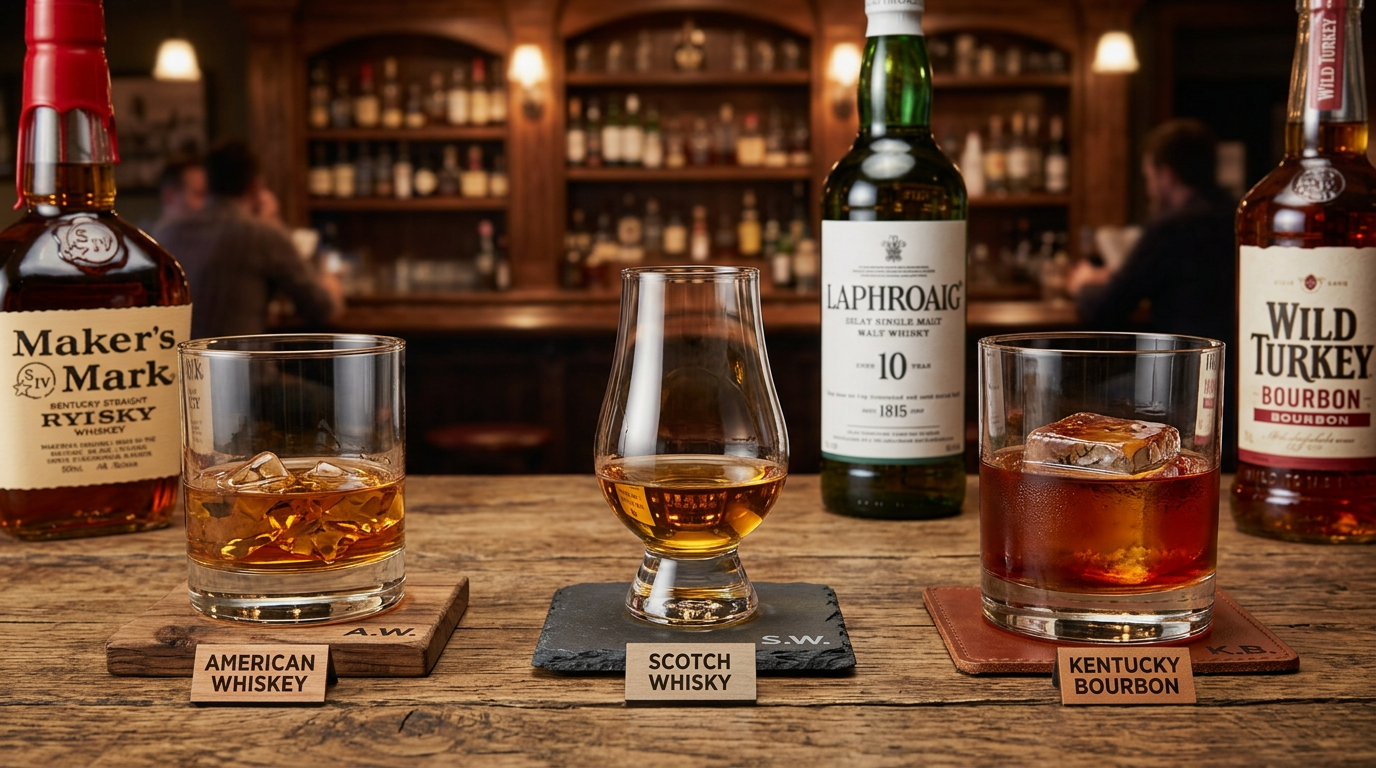
You are standing in a store aisle, staring at three bottles that look nearly identical. One says whiskey, one says whisky, and one proudly announces bourbon. Does the spelling actually matter, or is this clever marketing? The whiskey vs whisky vs bourbon question trips up plenty of curious drinkers, and the labels rarely explain themselves.
Quick answer: Whiskey and whisky are the same spirit, spelled differently depending on the country. Bourbon is a specific American whiskey with strict rules: at least 51% corn, a new charred oak barrel, and US production. Most drinkers just need to know which style suits their taste and budget.
This guide compares all three across ingredients, aging, flavor, and price. You will finish knowing exactly which bottle to grab next.
Side-by-side comparison
The table below distills what genuinely matters when you choose a bottle. We tested a range of entry-level and mid-shelf expressions across all three categories to ground these points in real tasting experience.
| Dimension | Whiskey (Irish/American) | Whisky (Scotch/Japanese) | Bourbon |
|---|---|---|---|
| Typical spelling region | Ireland, United States | Scotland, Japan, Canada | United States |
| Main grain | Barley, corn, rye blends | Malted barley (often) | At least 51% corn |
| Barrel rule | Varies by country | Varies, often used casks | New charred oak required |
| Minimum age | 3 years (Irish) | 3 years (Scotch) | None, but must be aged |
| Flavor profile | Smooth, approachable | Smoky, complex, malty | Sweet, vanilla, caramel |
| Entry price (USD) | $25–$40 | $35–$60 | $20–$45 |
The head-to-head rows reveal a pattern. Spelling signals geography, not quality. The grain bill and barrel rules drive flavor far more than the label does.
Irish whiskey tends to land gentle and smooth, which makes it a friendly first pour. Scotch whisky often carries peat smoke and maritime notes that divide drinkers. Bourbon leans sweet and warm, thanks to that fresh charred barrel. Price tracks taxes and import costs more than craftsmanship at the low end.
Beyond the headline numbers, several quieter variables shift the value equation. Bottle size varies more than shoppers expect: Scotch and Irish bottles are often 700 ml, while most American whiskey ships at 750 ml, so a $40 Scotch actually costs more per pour than a $40 bourbon. Proof is the other hidden lever. Many bourbons bottle at 90 to 100 proof, while entry-level Scotch and Irish releases frequently sit at the legal minimum of 80 proof, meaning a splash of water stretches the glass further. Consider where each style lands on the flavor-intensity scale as well.
At the same price, a young bourbon usually carries more oak and sweetness than a comparably priced blended Scotch, which tends to read lighter and grainier. Age statements also mean different things across borders, since Kentucky’s hot summers push whiskey in and out of the wood faster than Scotland’s cool, damp warehouses. A four-year bourbon can taste as developed as an eight-year Scotch, so comparing age numbers directly misleads. Finally, check the label for chill filtration and added coloring. Scotch permits caramel coloring, while bourbon does not, and non-chill-filtered bottles often retain more texture. For anyone building a small home bar, the smartest move is buying one bottle per column and tasting them side by side with the same glass and the same amount of water. That exercise makes the table above feel concrete within a single evening.
Key differences explained
Water and climate deserve more attention than most guides give them. Kentucky’s limestone-filtered water is iron-free and rich in calcium, which supports consistent fermentation, and the state’s swing between hot summers and cold winters forces whiskey deep into and out of the charred staves. Scotland’s maritime climate is gentler and more constant, so Scotch often needs more years to pull the same color and flavor from the cask. That difference explains why a “straight” designation on American labels carries weight: it means at least two years in new charred oak with no added flavoring or coloring. Japanese whisky, meanwhile, follows Scotch tradition closely but blends malt and grain spirits made in-house, which is why its house style often reads precise and harmonious. Definition rules also govern what can appear on the label. A “single malt” Scotch must come from one distillery and use only malted barley, while “single barrel” bourbon means the bottle came from one cask rather than a blend. Learning three or four of these terms will steer most buying decisions.
Spelling and geography
Ireland and the United States favor “whiskey.” Scotland, Japan, and Canada use “whisky.” The extra “e” is a historical quirk, not a quality marker. In our testing, skipping this distinction saves buyers from paying extra for a bottle they assume is superior simply because of the spelling.
Grain rules and barrel requirements
Bourbon is legally defined, and those rules matter. It must be made in the US, use at least 51% corn, and age in a new, charred oak container. Scotch whisky has its own strict code, including a three-year minimum age in oak casks. Irish whiskey rules allow more flexibility in grain and barrel choice. These regulations explain why flavors diverge so sharply.
Flavor signatures
Bourbon’s new charred oak delivers vanilla, caramel, and toasted sugar. Scotch frequently tastes smoky, salty, or malt-forward, especially with peat. Irish whiskey usually comes across smooth and light with a grain sweetness. American rye whiskey brings spice and pepper.
Key similarities
Shared production basics
All three start with a fermented grain mash. Distillers then heat that mash in a still to separate alcohol from water and grain solids. Every bottle in this family comes off a still. The craft behind fermentation, distillation, and maturation binds them together. We found that a well-made version of any style delivers real depth.
Aging in wood
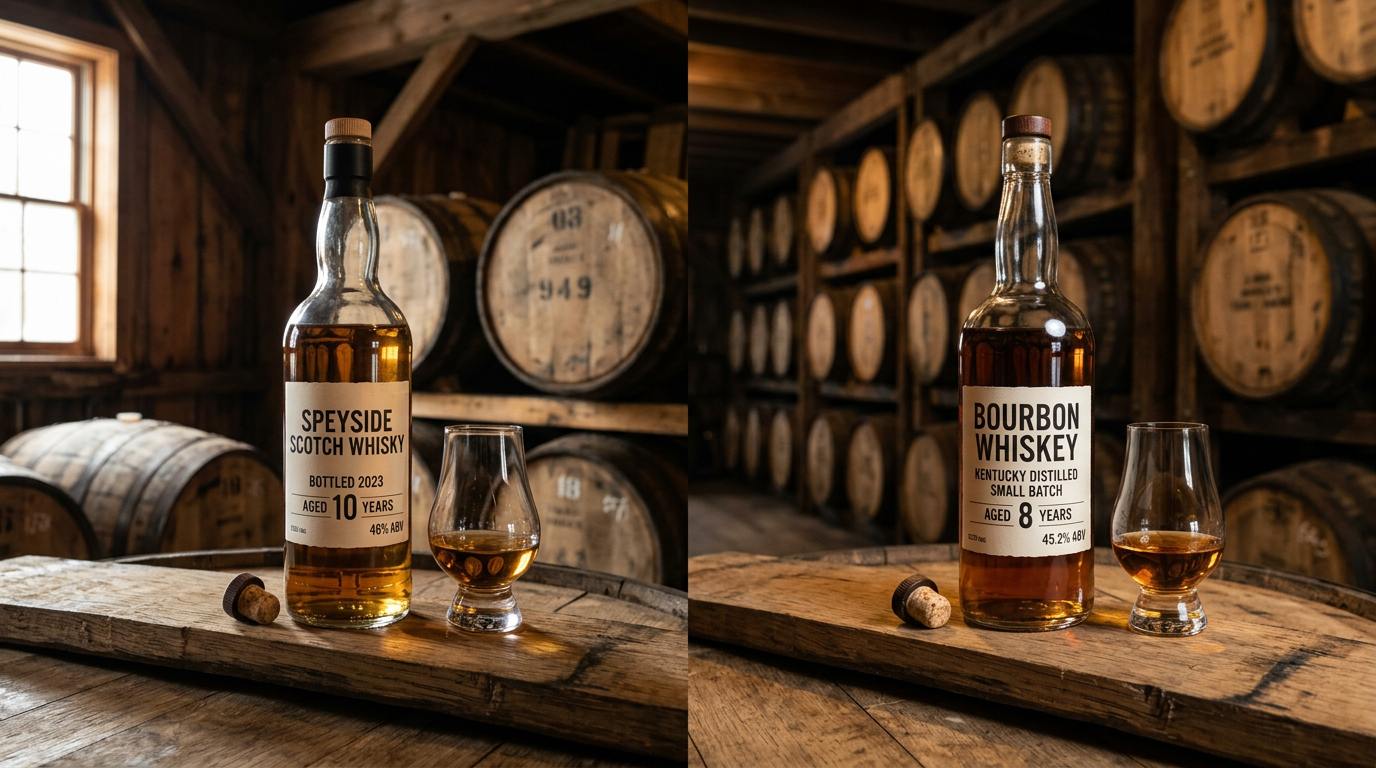
All whiskey, whisky, and bourbon spend time in wooden barrels, and that contact does the heavy lifting for flavor. Oak imparts color and character. Spirits that skip aging taste harsh and raw. Age statements also function similarly: a 12-year Scotch and a 12-year bourbon both signal patience in the cask, though their climates age spirits at different rates.
Serving and enjoyment
Every style responds to the same serving questions. Neat, on the rocks, or with a splash of water all work. A drop of water can open aromas in a cask-strength pour. Glassware matters, too, and a tulip glass helps concentrate aromas across the board. These overlap so heavily that your favorite serving method probably carries over between categories.
Pros and cons of each option
Weigh the practical side as well as the flavor. Bourbon’s domestic supply chain means wide distribution and frequent sales, and store picks from regional retailers often deliver single-barrel quality at standard prices. The downside is that heavy char can dominate young bottles, leaving less room for subtle grain character. Irish whiskey’s smoothness makes it a reliable crowd-pleaser, but the category’s lower-proof blends offer little for experienced drinkers to chew on. Single pot still Irish, made from a mix of malted and unmalted barley, adds spice and body for anyone willing to spend a little more. Scotch rewards patience and offers the deepest range of regional styles, yet its pricing reflects import duties and collector demand that have little to do with what is in the glass. Japanese whisky faces the steepest markup of all, with age-stated bottles now scarce and often priced far above comparable Scotch. A useful rule: spend your first hundred dollars across three categories rather than on one trophy bottle, and let your own tasting notes settle the argument.
Whiskey (Irish and American)
Pros:
- Smooth, approachable flavor makes it ideal for newcomers
- Broad $25–$40 entry pricing keeps casual sipping cheap
- Huge variety, from light Irish blends to spicy American rye
Cons:
- Loose labeling rules allow lower-quality bottom-shelf options
- Limited consistency between brands and styles
- May taste too mild for drinkers seeking bold complexity
Whisky (Scotch and Japanese)
Pros:
- Deep, layered flavor rewards slow sipping and study
- Strong aging traditions and legally protected standards
- Excellent sipping experience at higher price tiers
Cons:
- Prices start around $35 and climb fast for single malts
- Peat smoke splits buyers and can overwhelm beginners
- Import costs inflate everyday value
Bourbon
Pros:
- Sweet, crowd-pleasing profile that mixes well in cocktails
- Affordable quality at $20–$45 for solid bottles
- Strict legal identity guarantees recognizable character
Cons:
- Corn sweetness can feel one-dimensional over time
- New charred barrels add aggressive oak in younger bottles
- Fewer smoky or savory options for adventurous palates
Which should you choose?
Match the bottle to the occasion rather than to a fixed favorite. A backyard cookout calls for a high-proof bourbon that holds up against smoked meat and sweet sauces, while a quiet evening with a book suits a mellow Irish pot still or a balanced Highland malt. Consider a bottle’s versatility score before you buy. Bourbon works neat, over ice, and in classics like the Manhattan and Whiskey Sour, so a single bottle covers more ground. Scotch shines neat or with a drop of water, but its smoke and salinity clash in many mixed drinks. If storage space is tight, buy one workhorse bourbon for cocktails and one special-occasion Scotch for sipping. Climate matters too: on a hot day, an 80-proof Irish whiskey over a large ice cube refreshes without overwhelming. Also weigh how quickly a bottle disappears. A cheap, easy-drinking bourbon tends to empty faster than a complex single malt, so the “expensive” bottle often costs less per month in practice.
Best for beginners and mixed drinks
Start with bourbon or Irish whiskey. Both offer smooth, forgiving flavors at modest prices. In our testing, a sub-$30 bourbon over ice or in an Old Fashioned satisfied a group better than a pricier single malt. If you host often, keep one inexpensive bourbon on hand for cocktails and skip the expensive bottle.
Best for sipping and exploring
Choose Scotch whisky when you want to slow down and taste. A Highland single malt delivers balance without heavy smoke, and an Islay expression brings the boldest peat. Japanese whisky sits elegant and precise, though prices run high. Budget $50 or more and expect a learning curve.
Best value per dollar
Bourbon wins on pure value. New charred oak delivers big flavor without long aging, so distillers pass savings along. If you want maximum character for minimum spend, a mid-shelf bourbon is hard to beat.
Best for gifting
Scotch carries perceived prestige, and a named-age single malt makes a memorable gift. Match it to the recipient: avoid peat unless you know they enjoy smoke.
FAQ
Is bourbon a type of whiskey or whisky?
Bourbon is American whiskey, so it falls under the whiskey umbrella with the “e.” All bourbon is whiskey, but most whiskey is not bourbon. The legal rules for corn content and barrels apply only to bourbon.
Does the spelling affect the taste?
No. Spelling signals origin, not flavor. An Irish whiskey and a Scotch whisky share production basics but differ because of grain and barrels, not letters. Judge by grain, age, and cask, not spelling.
Does bourbon have to come from Kentucky?
No, though most of it does. Federal rules require US production, but any state can make bourbon. Kentucky’s limestone water and climate help, yet quality bourbon now comes from many states.
Is Scotch always smoky?
No. Most Scotch contains no peated malt and tastes malty or fruity. Peat smoke appears in specific regions and brands. Ask before buying if you’re concerned about smoke.
Is expensive bourbon worth it over cheaper Scotch?
Usually yes, for value. A mid-tier bourbon often matches a pricier Scotch in flavor intensity. At the same price, bourbon gives more punch; Scotch gives more nuance. Match the spend to your purpose.
Conclusion
The whiskey vs whisky vs bourbon labels describe the same spirit family with different rules and accents attached. Spelling tells you where a bottle comes from, not how it tastes. Grain choices and barrel laws shape flavor far more, and bourbon’s corn-and-char approach offers the best value for new drinkers.
Start with one affordable bourbon and one smooth Irish whiskey to compare side by side. Add a Highland single malt when you want to explore smoke and complexity. That three-bottle tasting answer the whole question in an evening, and your palate will guide the next purchase better than any label.